 Rep The Set
How to use AI to improve your workouts
An AI can read your workout data and find patterns you miss: the station that fades, the week that jumped too fast. Here is what the research says it is good for, where it stops, and five questions to ask it.
You finish a hard workout. Your watch has your heart rate. Your app has every round and every station.
Most of us look at the total time, feel happy or sad, and close the app. The rest of the numbers can tell you much more, and today an AI like ChatGPT or Claude can read them with you.
It sees patterns you miss
After a workout, you remember how it felt. You do not remember that your third round of wall balls was nine seconds slower than the first.
An AI reads every number at once. The most useful pattern is simple: your heart rate climbs, but your pace does not change. Your body is working harder for the same job.
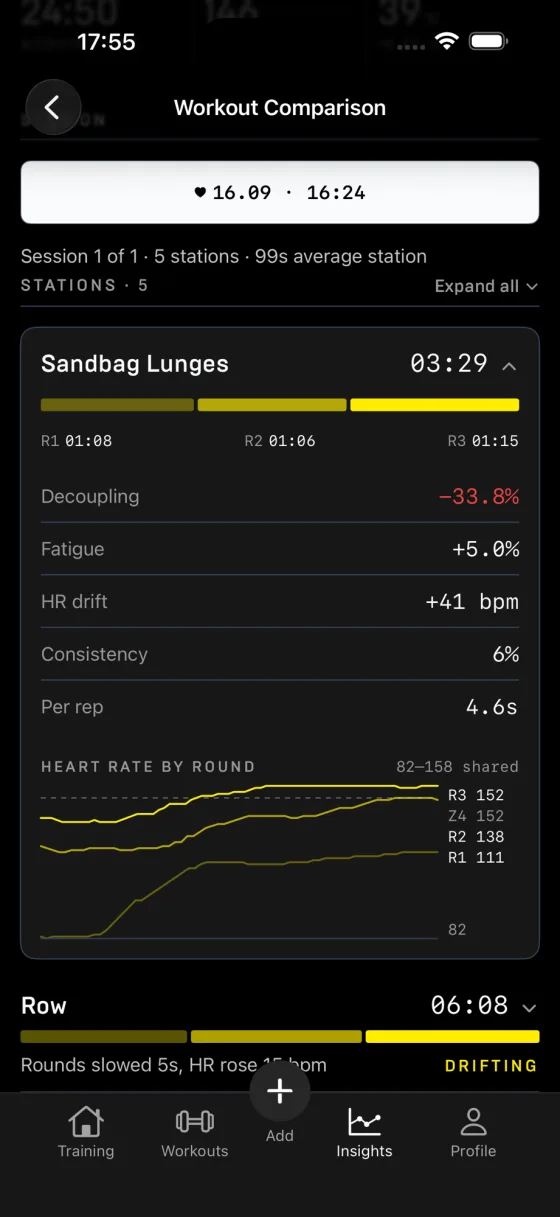
Scientists call this cardiac drift. Heat and drinking too little can cause it too, so it is a hint, not a verdict [9]. If it shows up on the same station every week, that station is probably your weak point.
- Which station gets slower when I am tired?
- Where did my heart rate rise while my pace stayed the same?
In Rep The Set: the analytics calculate the drift for every station, so you start with the answer, not a spreadsheet. Your last session is free; your full history comes with Pro.
What each number means: reading your session analytics.
It helps you plan the next workout
Once you know your weak point, you can train it. Ask the AI for a workout that targets it, and ask it to explain why.
Always ask for the timing too. How long will each round take? How much rest is there? A plan that looks easy on paper can be very hard in real life.
When researchers tested ChatGPT, its exercise advice was mostly correct but left out how hard, how often and how long [4]. Another study found AI training plans too general to use without more work [5]. Use AI as a training partner, not as your coach.
- Build me a 30-minute workout for my weakest station, with rest and timing.
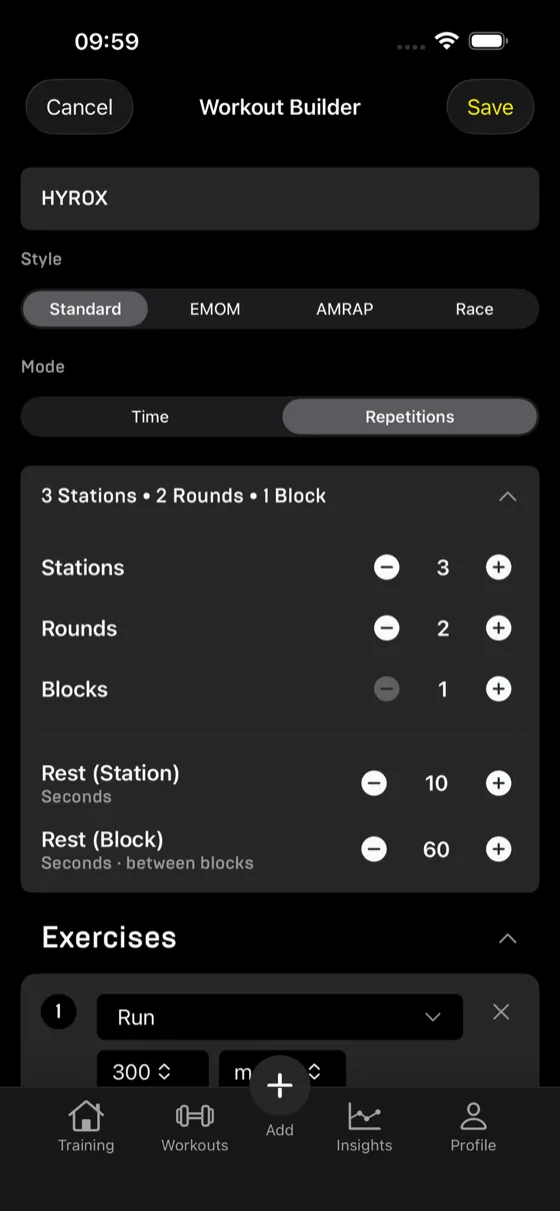
In Rep The Set: build the plan in the workout builder. With Pro, it shows how long a Beginner, an Advanced and an Elite athlete would take, station by station, before you press start.
No app yet? The free band calculator prices any workout at the three levels.
It can help you avoid "too much, too soon"
This is the big one. Many training injuries do not come from training itself. They come from a sudden jump in training [1].
You feel great, you add two extra sessions and longer runs, and two weeks later your knee hurts. Athletes who build up slowly can handle a lot of training. Athletes who jump up quickly get hurt more often [1].
Some coaches use a formula that compares your last week with your last four. Newer reviews say it is not reliable enough to predict injuries [2] [3]. There is no magic number. The simple idea still holds: build up in small steps.
- Compare my training this week with my last four weeks. Is this a big jump?
- Which weeks were the hardest, and how did I feel after them?
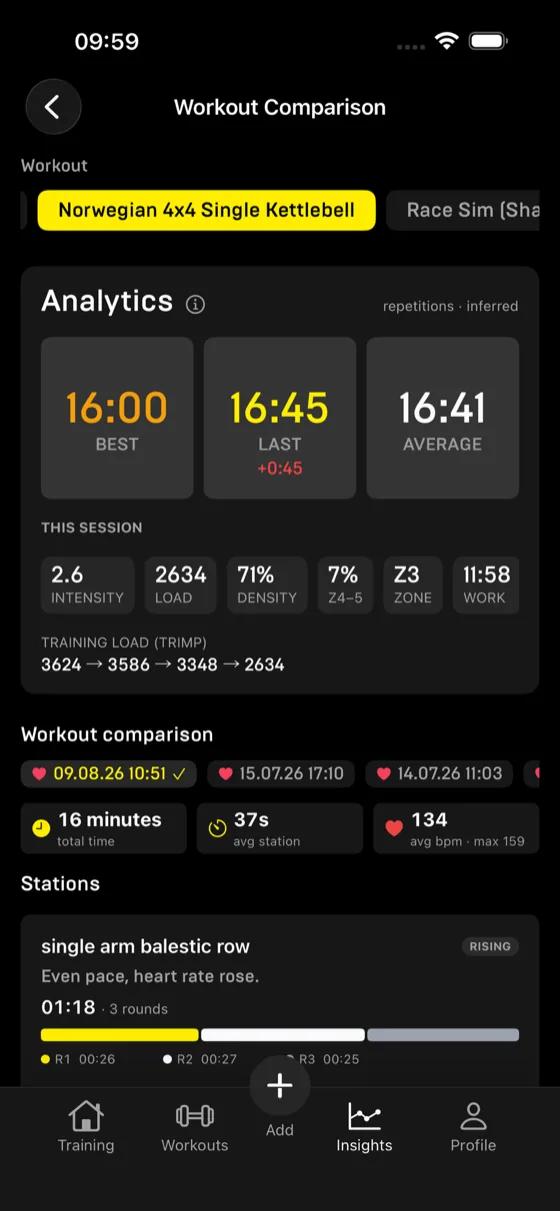
In Rep The Set: every session gets a load number, built from your heart rate and the time you spent working. With Pro, your full history goes into the export, so the AI compares weeks instead of guessing.
Your feelings are data too
You do not need a heart-rate strap to measure how hard a workout was.
After each session, rate it from 1 (very easy) to 10 (maximum). Multiply by the minutes you trained. A 45-minute workout at 7 out of 10 scores 315.
Tell the AI your scores. Over a few weeks, it can show you when your weeks go up too fast.
This is called session RPE. It sounds too simple, but 36 studies have tested it across many sports, ages and levels, and it works well for tracking how much you train [6].
Sleep counts more than you think
Training makes you tired. Sleep is when your body repairs.
If you track your sleep, share it with the AI along with your workouts. It may find that your bad sessions follow your short nights.
In one study of teenage athletes, those who slept less than eight hours a night were injured more often. Sleep was one of the strongest signals in the study, stronger than how much they trained [7]. A later review found the same link with long-term lack of sleep [8].
- Here are my sleep hours for the last two weeks. Do my worst sessions follow my shortest nights?
It cannot see your form
When you are tired, your technique gets worse. Your back rounds, your knees fall in, your steps get shorter.
An AI reading your numbers cannot see this. But the numbers give a hint: when a station suddenly gets much slower in the last round, ask yourself if your form was breaking down too.
When your form breaks, the set is over. Rest, or make the movement easier.
Researchers describe fatigue as one of the steps between hard work and muscle damage [10].
What AI cannot do
It is not a doctor. If something hurts, stop and talk to a doctor or a physiotherapist. Do not ask an AI to diagnose pain.
It only knows what you tell it. Missing sessions or wrong numbers give wrong answers.
It can sound sure and still be wrong. Ask it to show you the numbers behind every answer.
- Which station is holding me back, and how do you know?
- Where did my heart rate rise while my pace stayed the same?
- Is this week a big jump from my last four weeks?
- Build me a 30-minute workout for my weakest station, with rest and timing.
- What should I change next week, and what should I keep the same?
The first question is the one we asked about a real session. Here is what it found.
Try it with Rep The Set
Train with Rep The Set as usual. The timer, the builder and the voice cues are free.
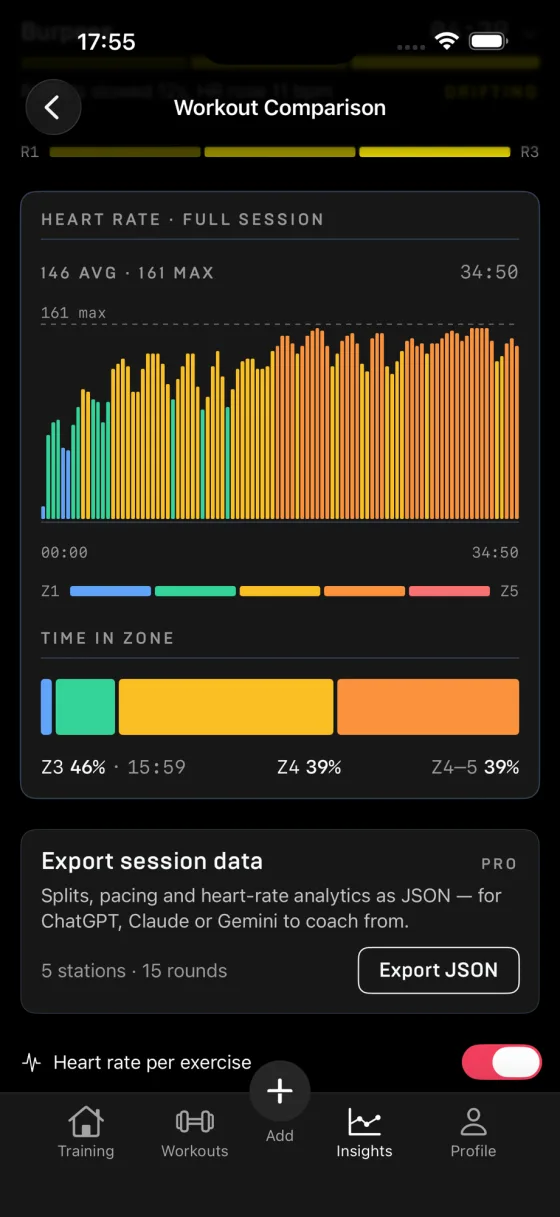
Afterwards, open the session and tap Export JSON. The whole session becomes one file, with every field explained inside it, so the AI understands it without a long message from you.
Drop the file into ChatGPT, Claude or Gemini and ask your first question.
You decide what to share. The file holds your workouts and, if you allowed it, your heart rate. Nothing else.
Export is part of Pro, a one-time purchase, not a subscription. Step by step: using Rep The Set with your AI.
Train hard, build up slowly, sleep well, and let the numbers do some of the thinking.
Sources
- Gabbett, "The training-injury prevention paradox", British Journal of Sports Medicine, 2016. Read it
- Maupin et al., the acute:chronic workload ratio and injury risk, a review, Open Access Journal of Sports Medicine, 2020. Read it
- The acute:chronic workload ratio for predicting sports injury risk, a systematic review and meta-analysis, 2025. Read it
- A study of ChatGPT’s exercise recommendations, JMIR Medical Education, 2024. Read it
- "Artificial intelligence in sport: exploring the potential of using ChatGPT in resistance training prescription", 2024. Read it
- Haddad et al., "Session-RPE method for training load monitoring", Frontiers in Neuroscience, 2017. Read it
- Milewski et al., sleep and sports injuries in adolescent athletes, Journal of Pediatric Orthopaedics, 2014 (a report of the findings). Read it
- A systematic review of sleep and injury in adolescent athletes, 2019. Read it
- "Do heart rates of elite marathon runners exhibit room for drift? Implications for durability". Read it
- Muscle fatigue as a step towards muscle damage and injury, Sports Medicine - Open, 2025. Read it